Understanding grades: what PSA 10, CGC 9.5 and BGS 9.5 mean
PSA, CGC and BGS attach different names to the same number: Gem Mint, Mint+, Pristine and Black Label. Centering, qualifiers and subgrades explained.
 Claudy· Guides & Tutorials

A grade is the number a grading service such as PSA, CGC or BGS (Beckett) uses to rate a card's condition on a scale up to 10. It is not a universal measurement: each of the three companies attaches its own names and requirements to the same number.
This guide walks through the tiers of all three companies, explains the technical terms you meet on labels and in the standards, and shows where the scales part ways. A note on sourcing: the PSA and Beckett details come from specialist articles that cite those companies' standards, and each statement names its source. Where only one source makes a claim, its name appears right in the sentence. Most of the CGC details come straight from CGC.
The reference table
The names the three companies put at the top of their scales:
| Company | Tiers at 10 | Name of the 9.5 |
|---|---|---|
| PSA | Gem Mint 10 | No PSA 9.5 |
| CGC | Pristine 10, Gem Mint 10 | Mint+ |
| BGS | Black Label Pristine 10, Pristine 10 | Gem Mint |
The sections below explain what each tier stands for.
Reading centering: what 55/45 means
Centering describes how evenly the design sits between a card's borders. Centering figures appear at all three companies, so the notation is worth understanding before looking at the individual scales. Geeky Domain explains that centering is given as the worst-case split between two opposing borders. 55/45 means the wider border takes up no more than 55 percent of the combined border width on that axis. A figure of 50/50 accordingly means both borders on that axis are exactly the same width.
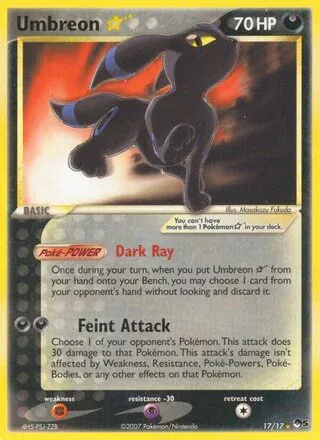
PSA and CGC give separate figures for the front and the back. On this card from the InSleeve catalog, it is the yellow border around the design whose opposite sides get compared. Geeky Domain adds that the back receives much more centering leeway than the front at every high PSA grade.
PSA 10: Gem Mint with nothing in between
PSA names its whole grades as follows: 10 Gem Mint, 9 Mint, 8 NM-MT, 7 NM, 6 EX-MT, 5 EX, 4 VG-EX, 3 VG, 2 Good and 1 Poor.
According to the PSA standards quoted by SamuraiSwordTokyo, a PSA Gem Mint 10 is a virtually perfect card. That means four sharp corners, sharp focus and full original gloss. Staining of any kind rules the 10 out. PSA may tolerate a slight printing imperfection as long as it does not hurt the card's overall appeal.
On centering, CardGrade cites PSA for the 10 at roughly 55/45 or better on the front and 75/25 or better on the back. The PSA standards quoted by SamuraiSwordTokyo add a related rule: at the discretion of the person grading the card, a small variance may occasionally be allowed when the card's overall eye appeal holds up. A card just outside the figure is not automatically out of the running.
Centering is only one part of the assessment anyway. For a 10, PSA also looks at corners, edges, surface, print quality and overall eye appeal. According to CardGrade, PSA does not publish a simple formula that weights four factors such as centering, corners, edges and surface against each other.
A PSA 9, per the quoted standards, shows all the attributes of a 10 but reveals one minor flaw on closer inspection. The standards give examples such as a very slight wax stain on the back, a minor printing imperfection or slightly off-white borders. For PSA 9 centering, Geeky Domain lists roughly 60/40 on the front and 90/10 on the back; for PSA 8, roughly 65/35 on the front and 90/10 on the back.
Qualifiers: the brackets after a PSA grade
Sometimes a PSA grade is followed by a code in brackets, for example PSA 8 (MK). That code is a qualifier. Prewarcards describes it as an added note about a defect that the number itself does not account for. Without the marking, that PSA 8 (MK) would be a regular PSA 8.
Geeky Domain lists six qualifiers:
- MK: marks such as writing or pen and pencil traces
- MC: a miscut
- OC: off-center
- ST: staining
- PD: a notable print defect
- OF: out of focus
Two rules help put them in context. First, PSA does not stack qualifiers, according to PreGradeCards: a card that misses several criteria simply receives the lower grade it earned. Second, submitters can choose a "no qualifiers" option. The card then gets the lower unqualified grade that the defect warrants instead of the bracket.
Not every company works with qualifiers. Prewarcards notes that the grading company SGC does not use them and factors the defect straight into the overall grade. When you compare a PSA grade with an SGC grade, keep the bracket in mind.
CGC 9.5: Mint+, not Gem Mint
CGC grades collectible cards on a 10-point scale that covers trading card games as well as sports and non-sports cards. The games it grades include Pokémon, Magic: The Gathering, Yu-Gi-Oh!, Flesh and Blood and Weiss Schwarz. According to CardGrade, Pristine 10 leads the scale, followed by Gem Mint 10 and Mint+ 9.5.
Pristine 10 is CGC's term for a card that is virtually flawless to the naked eye. It requires 50/50 centering and flawless color. On its trading card grading page, CGC adds that Pristine 10 is reserved for cards that are flawless under 10x magnification. Those cards receive a gold Pristine 10 label.
Gem Mint 10 is also an overall 10 at CGC, except that one criterion falls just short of the Pristine level. The corners look perfect to the naked eye and meet the Mint+ standard under 10x magnification. The surface has no print spots and full gloss. Front centering may not exceed roughly 55/45, back centering may not exceed 75/25.
Mint+ 9.5 is the grade from this guide's title. CGC describes it as a Mint card with premium eye appeal, for example from exceptional centering or high surface and color quality.
Mint 9 at CGC means four sharp corners with only minor wear and all original gloss. For trading card games, CGC allows a few minor manufacturing or handling defects at this tier. One detail matters for Pokémon collectors: CGC's Mint 9 centering figures (60/40 front, 90/10 back) apply only to sports and non-sports cards. For trading card games, CGC gives no centering figure at Mint 9.
According to CardGrade, CGC still evaluates centering, surface, corners and edges. The former CGC Perfect 10 is still known online, but CardGrade says it is no longer assigned. Under the CGC guarantee, every submission is inspected by at least two professionals.
BGS: four subgrades behind one number
According to CardGrade, Beckett grades under the BGS name on a scale from 1 to 10 with half grades.
What sets BGS apart are subgrades, separate scores for individual areas of the card. CardGrade says Beckett awards four of them: centering, corners, edges and surface. All Vintage Cards describes Beckett deriving the overall grade from those four subgrades. The same source says BGS offers grading with and without subgrades. Whether a card receives subgrades therefore depends on the service you choose.
At the top, CardGrade says the BGS label system separates the Black Label from other Pristine 10s:
- Black Label Pristine 10: all four subgrades are 10.
- Pristine 10 with a gold label: according to All Vintage Cards, one subgrade may be below 10.
For Pristine, CardGrade says Beckett requires 50/50 centering on the front and 55/45 or better on the back. On the front, that is the same dead-center figure CGC gives for Pristine 10.
Half grades
CGC awards half grades on cards, for example an 8.5. PSA takes its own route. CardGrade says PSA awards half grades up to and including 8.5. A half grade there recognizes a card that exceeds the standard of the lower whole grade without reaching the next whole grade.
Authentic: genuine, but no number
Not every card gets a number. CGC uses the designation Authentic (AU): the card is genuine and unaltered but receives no numeric grade. Authentic Altered (AA) at CGC means the card is genuine but altered, for example by recoloring or trimming.
According to Geeky Domain, PSA uses the same terms. PSA Authentic confirms a card is genuine without a numeric grade. Authentic Altered means genuine, but with evidence of trimming, recoloring, restoration or cleaning.
Grades and Cardmarket conditions
Cardmarket's glossary describes PSA as a grading service with a scale from 1 (Poor) to 10 (Gem Mint). Cardmarket itself, however, does not support Gem Mint as a condition and works with seven conditions of its own, from Mint to Poor.
What this means in practice
With a graded card in front of you, work through it in this order:
- Find the grading company on the label.
- Read the tier name, not just the number.
- On PSA, check whether a qualifier in brackets follows the grade; if so, the number alone does not tell the whole story.
- On BGS, see whether the card was graded with subgrades and whether it carries a Black Label.
- If the label says Authentic or Authentic Altered instead of a number, you are looking at a confirmation of authenticity.
If you are thinking about submitting cards of your own, our pre-grading check helps you inspect centering, corners, edges and surface. For how the conditions differ when you buy and sell raw cards, see card conditions explained. You will find more walkthroughs in the guides overview.
Card images: InSleeve catalog
Research & data: InSleeve team, AI-assisted, editorially reviewed.
Comments are coming later.