How to tell reprints apart: first edition vs. reprint
1st Edition stamp, drop shadow, text weight, set symbol and card number: how to tell first editions, Shadowless, Unlimited and reprints apart.
 Claudy· Guides & Tutorials
In Pokémon cards, a first edition (1st Edition) is a copy from the first, limited print run of a set. A reprint is a card that was printed again later: in a further print run of the same set or in a separate reprint set. On English cards you spot a first edition by its 1st Edition stamp. Later print runs and reprints give themselves away through a drop shadow (a dark shadow strip on the art frame), the set symbol (the small icon that marks which set a card belongs to), the card number and an anniversary logo.
This guide walks you through those features using Charizard, because the card exists in several printed versions. It covers English cards; Japanese cards get their own section at the end.
The reference table
| Version | Type | Charizard |
|---|---|---|
| Base Set, 1st Edition | first Base Set print run | 4/102 |
| Base Set, Shadowless | second Base Set print run | 4/102 |
| Base Set, Unlimited | later Base Set print run | 4/102 |
| Base Set 2 | reprint set | 4/130 |
| Evolutions | remake of the Base Set | 011/108 |
| Celebrations Classic Collection | anniversary reprint | 4/102 |
| 30th Celebration | anniversary reprint | 4/102 |
The sections below explain the features of each version.
The 1st Edition stamp
The stamp is a circle with a 1 inside it and the word EDITION arching over the top. On English and German first-edition Pokémon cards, meaning cards with a Pokémon as their subject, it sits directly to the left below the art window. The art window is the framed panel that holds the illustration.
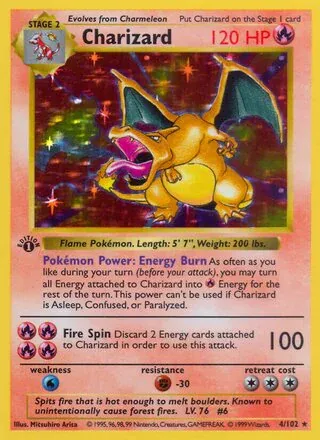
These English sets have a first-edition print run:
- Base Set
- Jungle
- Fossil
- Team Rocket
- Gym Heroes
- Gym Challenge
- Neo Genesis
- Neo Discovery
- Neo Revelation
- Neo Destiny
Neo Destiny, released in 2002, was the last English set to carry the stamp. Among the first 11 English sets, Base Set 2 is the only one without a first edition; it gets its own section further down.
That list is your first filter as a buyer: an English card with a 1st Edition stamp that comes from none of these ten sets is a fake.
The English Base Set launched in the USA on 9 January 1999 as a limited 1st Edition. The German Basis-Set reached shops in December 1999. The limited German booster displays of that first expansion, the retail boxes holding several booster packs, carry the line "Erste Edition in begrenzter Auflage" (first edition in a limited print run) next to the 1st Edition stamp.
Base Set: 1st Edition, Shadowless and Unlimited
The English Base Set has 102 cards and no set symbol. It went through several print runs that differ in small details:
- 1st Edition: with the 1st Edition stamp and without a drop shadow on the art frame.
- Shadowless: neither stamp nor drop shadow, hence the name.
- Unlimited: the drop shadow appears. It runs along the right and bottom edges of the art frame.
The text is the second clue. On first-edition and Shadowless Pokémon cards, the HP (hit points) and the attack text are printed thinner than on Unlimited cards, whose text is bolder.
Trainer and Energy cards have no art frame to look for a shadow on. You therefore place their print run by the copyright line, the small legal line with years and company names along the bottom edge.
There is also a late fourth print of the Base Set. Its main difference is the copyright year 1999-2000 instead of 1999. Most of this print went to the UK and Australia, which is why collectors often call it the UK print.
Listings often mislabel Shadowless cards, sometimes as Unlimited and sometimes even as 1st Edition. So look at the photos yourself instead of trusting the listing title. Shadowless is a purely English-language Base Set phenomenon, and no Shadowless card was ever printed in Japan.
One sign of a fake follows directly from this: a Base Set Charizard sold as a first edition that shows a drop shadow on the art frame is a fake.
That rule holds for Charizard, but not for every card in the set. Base Set Machamp was printed with the 1st Edition stamp in the 2-Player Starter Set, and the second print of that starter set shows the stamp together with the drop shadow. For Machamp, stamp plus shadow is not a contradiction.
Base Set 2: a reprint with its own number
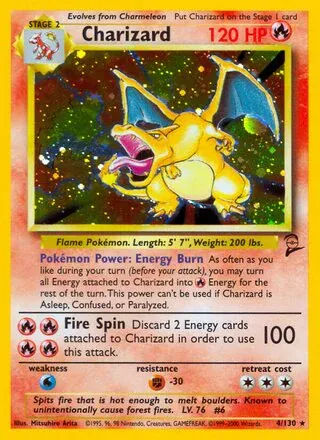
Base Set 2 came out on 24 February 2000 and contains no new cards. It consists of 130 reprints from Base Set and Jungle with new numbering. It was printed only as Unlimited and only in English, so no card in the set carries a 1st Edition stamp.
Two features give a Base Set 2 card away at once: its number counts out of 130, and a small set symbol sits at the bottom right below the art, which Base Set cards do not have. The Charizard artwork itself stayed unchanged.
Legendary Collection: reverse holos with a firework pattern
Legendary Collection is an English reprint set from 24 May 2002 with 110 cards, among them cards from Base Set, Jungle, Fossil and Team Rocket. Each of these 110 cards also exists as a reverse holo, a variant whose shiny foil sits outside the picture. In Legendary Collection that foil forms a firework pattern across the whole card except the art window. Like Base Set 2, Legendary Collection was only printed as Unlimited, so you will not find a 1st Edition stamp in it.
Evolutions: an anniversary remake
XY Evolutions came out on 2 November 2016 for the twentieth anniversary of Pokémon, as a remake of the Base Set with 113 cards. You can tell these cards by two features: they carry the Evolutions set symbol and a number out of 108, while Base Set cards are numbered out of 102.
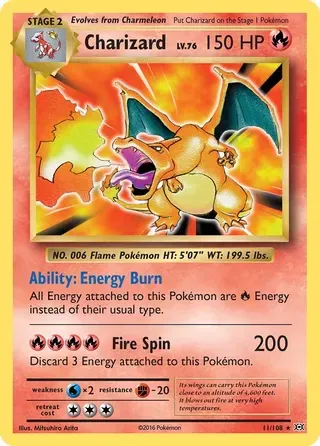
Charizard 011/108 from Evolutions uses the 1999 artwork. The card has 150 HP instead of 120, though, and a stronger Fire Spin attack. Same artwork does not mean same card.
Anniversary reprints with the original number
The anniversary reprints are trickier. The Classic Collection in the Celebrations set contains 25 near-identical reprints of classic cards with a Pokémon 25 stamp next to the artwork.
For Charizard, only the original and the anniversary reprints carry the number 4/102, while older reprints such as Base Set 2 have their own numbering. There are at least three Charizard cards numbered 4/102: the 1999 original, the 2021 Celebrations reprint with the 25th anniversary logo and the 2026 reprint with the 30th anniversary logo.
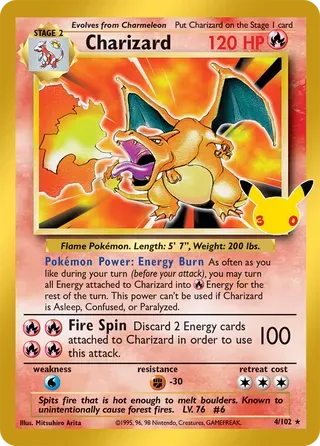
With 4/102, the number alone is not enough. On a Charizard with this number, always look for an anniversary logo. If there is one, that points to an anniversary reprint.
Edge cases: starter products and Japanese cards
Starter products: cards from beginner products such as the Kampfakademie are reprints from earlier sets. You can recognise them by a printed coloured symbol, for example a Pikachu or Charizard silhouette.
Japanese cards: different rules apply here. The Japanese base set (Expansion Pack) came out on 20 October 1996 with the same 102 cards as the English Base Set. Japanese Pokémon cards were not released as 1st Edition in those early years; that only changed with the Pokémon VS expansion in 2001 and lasted until the XY series in 2016.
For the Japanese base set, collectors tell the prints apart by the rarity symbol instead, the mark that shows how rare a card is. Later prints carry a circle, diamond or star at the bottom right, while the very first print from 1996 has none. Collectors call these cards No Rarity.
What this means in practice
Before you buy a supposed first edition, work through the features in a fixed order:
- Identify the set by its set symbol and card number. That tells you whether the set has a first edition at all.
- On a Pokémon card, look for the 1st Edition stamp below the art window. Without a stamp, a Base Set card comes from one of the later print runs.
- Check the art frame for a drop shadow. It separates Unlimited from 1st Edition and Shadowless.
- Compare the HP and attack text. Thin text fits 1st Edition and Shadowless.
- On a Charizard numbered 4/102, look for an anniversary logo. That rules out the 2021 and 2026 reprints.
When buying online, ask for sharp photos that clearly show the art frame, the stamp area, the text and the card number first. If one feature does not fit the stated print run, the cautious move is to skip the card and get a second opinion. More checks against fakes are in How to spot fake Pokémon cards. If Japanese cards interest you, Collecting Japanese Pokémon cards helps you get started.
Sources
Show sources
- Pokezentrum: meaning, stamp position and period of first editions, release dates, Japanese first editions
- Pokezentrum: reprints in beginner products and their coloured symbol
- Magic Madhouse: the ten English sets with a first edition and the shape of the stamp
- LoosePacks: the fourth Base Set print and mislabelled Shadowless listings
- Bill's Archive: Base Set print runs, text weight, Machamp and the Japanese base set
- Bill's Archive: Base Set 2 set symbol and numbering
- Bill's Archive: Legendary Collection and its reverse holo pattern
- Bill's Archive: XY Evolutions set symbol, numbering and Charizard 011/108
- Samurai Sword Tokyo: drop shadow, Trainer and Energy cards, Shadowless and Japanese No Rarity prints
- Marriland: the Celebrations Classic Collection with its Pokémon 25 stamp
- Cards N Packs: Charizard versions numbered 4/102
- Geeky Domain: a shadowed Base Set Charizard as a sign of a fake
Card images: InSleeve catalog
Comments are coming later.